Fractals


An informal definition of a fractal set is one which satisfies the self-similarity property. That is, the set will have a similar appearance at different scales.

Koch Snowflake


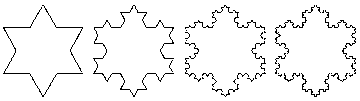
One of the more intuitive sets of this form is the set whose graph is called a Koch snowflake.

For an interactive graph of part of the snowflake, see the Koch function

Mandelbrot Set


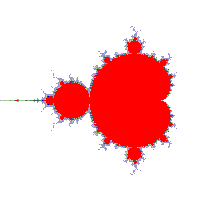
One of the more complex sets of this form is the set called the Mandelbrot set which is shown below.

If your browser will run Java programs, look at the Mandelbrot set where you can demonstrate the self-similarity property interactively. Go directly to the mathematics link if you wish to learn something about the mathematics behind the Mandelbrot set.

Julia Set


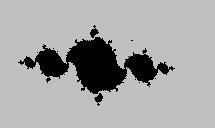
A related set is the Julia set where you can create self-similar sections of the graph.

The mathematics in this case is very similar to that of the Mandelbrot set except that the same constant c is used for the entire computation.

For another interesting Julia set, see the Julia set for Sin z.
Newton's Method


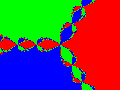
Another interesting fractal is that formed by using Newton's method to find the cube roots of 1 in the complex plane. This yields an interesting complex pattern which may be further investigated in Newton's method.

Some of the mathematics of this technique may be further studied in Example 2 of the link to a website on chaos.

Iterated Function Systems


Iterated Function Systems are used to form some fern-like pictures as well as the Sierpinski triangle.

Different examples can be seen using Java in Iterated Function Systems.

The mathematics of Iterated Function Systems can be further examined at this link.

L-Systems


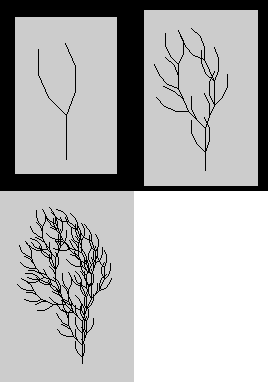
L-Systems are used to generate tree-like shapes and other self-similar pictures. To see how this is formed, look at a bush formed recursively To study the method of forming this bush, see the L-System link.


Bifurcation


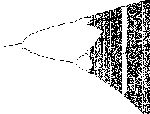
Another fractal which shows self-similarity is the bifurcation shown in the logistic equation

xnew = xold*r*(1-r).

The mathematics of this technique may be further studied in Example 1 of the link to a website on chaos.

Additional information can be found in the following web sites:


If you wish to send e-mail, do so at dkiel@dkiel.com